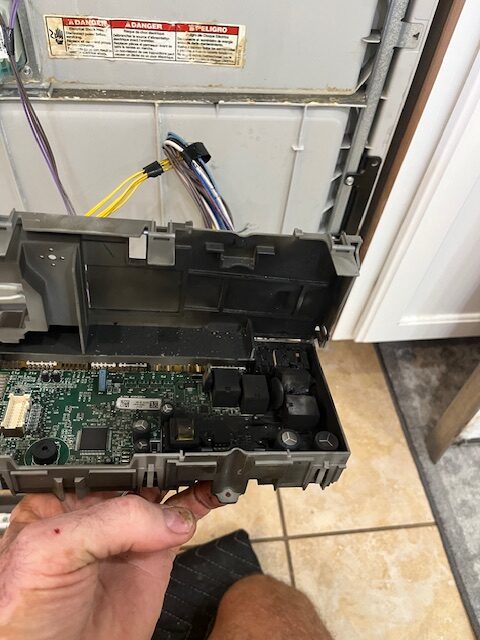
If you’ve been running your dryer twice just to get clothes dry, you’re not imagining it — and you’re not alone. It’s one of the most common calls I get from homeowners in Queen Creek, Gilbert, and San Tan Valley. Most people just chalk it up to a “quirky” dryer or large loads. But here’s the truth: a dryer that can’t finish the job in one cycle is a dryer that’s telling you something is wrong.
And it’s costing you money every single time you hit that start button again.
What One Extra Cycle Actually Costs You
Let’s do the math. A standard electric dryer uses about 5 kilowatt-hours (kWh) per cycle. With APS rates averaging around $0.13–$0.15 per kWh, that’s roughly $0.65–$0.75 per load. Run every load twice and you’re doubling that — every day, every week, every month.
For a family in Queen Creek or San Tan Valley doing 8–10 loads a week, running the dryer twice on every load adds up to $250–$300 in wasted electricity per year. That’s before you factor in the extra wear and tear on the machine itself.
The good news? In most cases, the fix is straightforward — if you catch it early.
The 5 Most Common Reasons Your Dryer Won’t Dry in One Cycle
1. A Clogged or Restricted Dryer Vent
This is the number one culprit I find when I’m called out to homes in Gilbert, Queen Creek, and the San Tan Valley. Your dryer vent is supposed to exhaust hot, moist air to the outside of your home. When that vent gets clogged with lint — or if it’s crushed, kinked, or too long — that humid air has nowhere to go. Your clothes stay damp no matter how long the cycle runs.
Signs it’s your vent:
- Clothes feel hot but still damp at the end of a cycle
- The outside of your dryer is unusually hot to the touch
- The laundry room itself feels humid or muggy while the dryer is running
- A full cycle takes 60–70+ minutes and still doesn’t finish the job
A restricted vent isn’t just an efficiency problem — it’s a fire hazard. The U.S. Fire Administration estimates nearly 3,000 home dryer fires happen every year in the U.S., and lint buildup in venting is the leading cause. In Arizona’s dry climate, lint accumulates faster than most homeowners realize.
What to do: Check that your exterior vent flap opens freely when the dryer is running. If it doesn’t, or if you can’t remember the last time your vent was cleaned, call a professional. This one is worth getting right.
2. A Failing Heating Element (Electric Dryers)
If your dryer is spinning and running but just blowing lukewarm air, there’s a good chance the heating element has partially failed — or is on its way out. A fully failed heating element means no heat at all. A partially failed element means inconsistent heat: sometimes it works, sometimes it doesn’t, and your clothes end up damp and frustrated.
This is one of the most common dryer repair calls I make across the East Valley. Heating elements wear out over time, especially in machines that have been working overtime.
Signs it’s your heating element:
- Clothes spin fine but come out damp or cool
- The dryer drum feels barely warm after a full cycle
- You notice the heat seems inconsistent — some loads dry fine, others don’t
The good news: a heating element replacement is one of the more affordable dryer repairs, and in most cases the machine is absolutely worth fixing.
3. A Blown Thermal Fuse
Your dryer has a thermal fuse — a small safety device designed to blow if the dryer overheats. Once that fuse goes, many dryers will still run (the drum spins, the timer counts down) but they produce zero heat. It’s a sneaky problem because everything seems to be working.
The thermal fuse itself is inexpensive. But here’s the thing: a blown thermal fuse almost always means something else caused the dryer to overheat in the first place — usually a clogged vent. If I replace only the fuse without addressing the root cause, it’ll blow again.
This is why I always check the full system when I’m diagnosing a no-heat dryer in Queen Creek or Gilbert.
4. Worn or Broken Moisture Sensors
Most modern dryers have moisture sensors — two small metal bars inside the drum that detect when clothes are dry and automatically end the cycle. When those sensors get coated with dryer sheet residue, or when they wear out, the dryer either stops too early (leaving clothes damp) or runs too long (wasting energy and beating up your clothes).
Easy test: Wipe the sensor bars (usually inside the door opening, near the lint trap) with a cotton ball and a little rubbing alcohol. If your dryer performs noticeably better after that, the sensors were dirty — not broken.
If cleaning doesn’t help, the sensors may need replacement.
5. Overloading — But Not in the Way You Think
Yes, too-large loads can prevent clothes from drying properly. But I also see the opposite problem: homeowners who bought a large-capacity dryer and are under-loading it. A drum that’s only a quarter full on an auto-dry cycle may confuse the moisture sensor into ending the cycle before everything is actually dry.
For best results, fill the drum about halfway to three-quarters full — enough for clothes to tumble freely, but enough mass for the sensor to read accurately.
Arizona’s Climate Makes This Worse
Here’s something I see constantly in Queen Creek, Gilbert, and San Tan Valley that homeowners in other states don’t have to think about as much: monsoon season.
From July through September, ambient humidity spikes dramatically compared to the rest of the year. That extra moisture in the air makes it harder for your dryer to exhaust heat effectively — especially if your vent is even slightly restricted. A dryer that barely kept up in May can suddenly seem broken in August. It’s often the same machine, just fighting harder against the conditions.
The flip side: during our dry winter and spring months, many of these same issues can hide because the dryer almost keeps up. Don’t let a few months of decent performance convince you everything is fine.
When to Call for Dryer Repair in Queen Creek, Gilbert, or San Tan Valley
A good rule of thumb: if your dryer has been running two cycles on a regular basis for more than a few weeks, it’s time to have it looked at. These problems don’t fix themselves — they get worse, and they’ll eventually turn a $150 repair into a $400 one, or turn an inconvenience into a fire risk.
Call Rock Solid Appliance Repair if:
- Clothes consistently come out damp after a full cycle
- Your dryer feels extremely hot on the outside
- You notice a burning smell coming from the dryer or vent
- The dryer runs but produces little or no heat
- You can’t remember the last time your vent was cleaned (especially if the run is long or has multiple turns)
I serve Queen Creek, Gilbert, San Tan Valley, Chandler, Mesa, Apache Junction, Gold Canyon, and Florence. Most dryer repairs can be scheduled within 24–48 hours, and many are completed the same day.
Is It Worth Repairing My Dryer?
That depends on the age of the machine and the cost of the repair. As a general guideline:
- Under 6 years old: Repair almost always makes sense. Most components are relatively affordable, and the machine has a lot of life left.
- 6–10 years old: Depends on the repair. I’ll always give you an honest assessment. If the repair is more than 50% of the cost of a comparable new unit, replacement may be the smarter move.
- Over 10–12 years old: Still worth evaluating. A $120 heating element on a 12-year-old Whirlpool is usually still a win — especially compared to paying $800+ for a new machine today.
I don’t upsell repairs that don’t make sense. My job is to give you the honest picture and let you decide.
Text or Call Shane Today
If your dryer is taking two cycles, don’t keep throwing electricity (and time) at the problem. Text or call Rock Solid Appliance Repair at 206-305-1355 to schedule a diagnostic visit in Queen Creek, Gilbert, San Tan Valley, or anywhere in the East Valley.
Diagnostic fee is $85 — and it’s waived entirely if you move forward with the repair.
Rock Solid Appliance Repair | Queen Creek, AZ | Serving the East Valley 📞 206-305-1355 | Mon–Fri 8am–5pm